Showing posts with label Montessori method. Show all posts

Friday, March 31, 2023

The 3 Roles Involved in a Montessori Middle School Environment

The 3 Roles Involved in a Montessori Middle School Environment


Typically, the Montessori-style middle school environment is represented by a triad of roles that include teachers, parents, and students. During class-time, these roles are viewed slightly differently, with the prepared Montessori environment itself taking on a role of its own. This is not instead of the parental role-- much of which takes place at home-- but as a cornerstone in the classroom learning process.

1. The Child

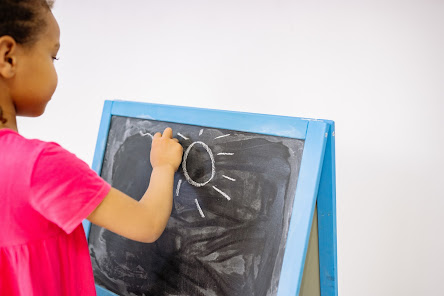
In Montessori education, the child is seen as an active participant in their own learning. The child is encouraged to explore, discover, and learn at their own pace and according to their own interests. The child is also encouraged to develop self-discipline, independence, and a sense of responsibility for their own learning. Montessori middle school students are often involved in their own parent-teacher conferences. They take an active role in discussing their progress and goals with their parents and teachers.

2. The Prepared Environment

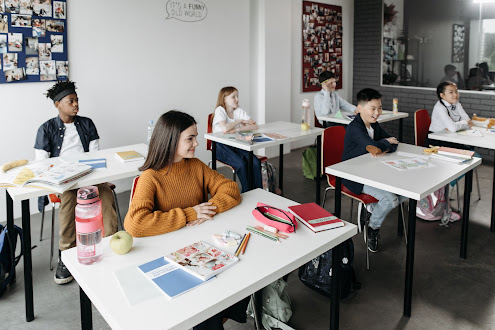
The Montessori prepared environment is carefully designed to meet the developmental needs of each child. The environment includes a variety of hands-on learning materials that are designed to promote exploration, discovery, and independent learning. The environment is also organized and structured to promote order, concentration, and self-discipline. Montessori students are encouraged to take ownership of their learning process. They are given the freedom to choose their own learning activities and are supported in pursuing their own interests and passions.

3. The Teacher

The Montessori teacher is responsible for creating a supportive and nurturing learning environment that meets the needs of each individual child. The teacher observes the child's interests, strengths, and challenges and provides guidance and support as needed. The teacher also prepares and maintains the learning materials and activities in the classroom, ensuring that they are appropriate and engaging for each child.

Montessori middle school students are encouraged to work collaboratively with their peers. They engage in group projects and discussions that allow them to learn from and with each other.

Together, these three roles of the Montessori triad work in harmony to support each child's development and growth. The teacher creates a supportive and nurturing environment, the child is an active participant in their own learning, and the prepared environment provides the materials and structure to facilitate learning and growth. This approach fosters a love of learning and a lifelong commitment to personal growth and development.
Tuesday, January 31, 2023

3 Leading Philosophies of the Montessori Method in Middle School

3 Leading Philosophies of the Montessori Method in Middle School


From daycare through middle school, Montessori students play the leading role in their education. Instead of lecturing the class as a group, teachers observe children's progress and guide them toward successful goals. The end goal is to build tomorrow's strong leaders, with the academic, social, and physical skills necessary to be whatever they wish.
 

1. Self-Directed Work

A Montessori middle school engages children in hands-on work that has value. Children select their own work, using self-correcting activities, performing experiments, and more. This freedom to choose for themselves means that children take a more active role in their own projects. Guiding without dictating is at the heart of the Montessori Method, whether the children are developing critical thinking skills with science activities or discovering the mathematics of geometry.

2. Responsibility and Self-Esteem

Respect for the child is one of the prime directives of Montessori. Middle school kids are not subordinate human beings, but members of a globe-spanning human family. Everyone has a right to believe, and to be heard, and this helps each child develop self-esteem, positive social skills, and the confidence necessary to not only think, but to act, for themselves.

3. Time to Learn

The Montessori school day is not broken into many small parts the way it is done in traditional public schools. Instead, children have extended period lengths, and typically remain in one class for most of the day. The idea is that unbroken lengths of time allow children more opportunities to work with concepts and projects, leading to improved retention of information, and a vibrant interest in the learning process.

Children are the most important part of a Montessori education. By providing them with a framework of expectations and the freedom to pursue individual accomplishments, children develop intrinsic motivation. This internal drive to achieve and discover is vital to the process, and why Montessori students are able to play such an active role in what and how they learn.

Friday, July 29, 2022

Montessori Elementary School and Its Influence

Montessori Elementary School and Its Influence


In 1907, Maria Montessori opened the first Casa de Bambini, or Children's House. Since then, Montessori education has spread around the planet and is now used in thousands of schools on every continent. From daycare to middle school and beyond, Maria Montessori has left a lasting legacy that is slowly changing how children are taught.

Hands-On Learning

Private middle school uses hands-on activities as the primary form of instruction. These activities are engaging and self-correcting, allowing children to build confidence and self-esteem by correcting their own mistakes. Play-based learning is gaining popularity in more traditional educational systems today, but it has always been a critical aspect of the Montessori Method.

Child Centric Development

The children themselves, not the subject being taught, are always at the forefront of the Montessori Method. From developing fine and gross motor skills to helping children develop strong language and writing skills, the focus is on each child, not on keeping the whole class working on the same lesson at the same time.

Discipline Without Punishment

Montessori does not use threats or physical punishment to maintain discipline. Instead, children learn that appropriate behavior is valued, and straying from that behavior results in unwanted consequences such as going into timeout, being left out of engaging group activities, and more. Children learn to act in preferential ways because they want to be meaningful members of the group, not because they are afraid of being punished.
 

Leadership Through Confidence

At the heart of the Montessori Method is a child who is self-confident, aware of how their actions affect others, and personally invested in their own educational progress. Maria Montessori recognized that children who feel good about themselves are more willing to do good things for others, take risks, and apply themselves to solving problems and reaching goals.

A Dynamic Triad

There are 3 major factors in Montessori education. The first and most important part is the child, but the adults-- generally parents and educators-- form an equally valuable aspect. The triad is rounded out through a carefully prepared environment that regulates activities and guides progress without hampering the individual freedoms of the children it serves. To be successful, the Montessori Method requires all 3 aspects to be present and work in unison for the good of the individual child.

Not every aspect of the Montessori Method is available in traditional schools and the name Montessori is not trademarked. Before you enroll your children in a school that claims to be Montessori, take the time to verify that you are working with an authentic Montessori facility.